To be or not to be, exempt that is…

Pastor, if you’ve not given much thought to how you will respond to a request for religious exemption from the COVID-19 vaccine, let this be your encouragement to do so. Here is a helpful article to aid your thinking and here’s why you should read it:

It’s thoughtful

As Christians, we can nuance problems and issues to arrive at a better conclusion because God’s Word and His Spirit guide us. Everything is not as black and white as you would like it to be. Wisdom does not work that way. Just take a look at Proverbs. In one moment, riches are evil, and in another, it’s a sign of unrighteousness. It’s not black and white; one must have the fortitude to consider deeper things when making ethical decisions. We know the truth and then apply that truth to our situation.

If an MLB player thinks he is only getting fastballs, he will fail miserably when the curveball comes his way. No, he must apply what he knows about hitting and adjust. If you, Pastor, think you will only get theological fastballs that can be hit easily, well, when the ethical curveball comes your way, you might strike out.

It defines what constitutes religious exemption well

Defining terms and issues clearly are of utmost importance. We cannot arrive at a healthy decision if we don’t know what makes something right or wrong. It might be possible that one is claiming religious exemption when they are actually misguided and working from preference, philosophical presuppositions, or political identity.

If you go swinging at balls outside the strike zone, well, you will not be successful. If we go swinging at issues not in the strike zone of biblical mandates, we will not do very well at being moral people.  

(By the way, if you’ve not read The Science of Hitting by Ted Williams, you should. It might help you develop critical thinking skills. He was way more thoughtful about hitting than most pastors are about pastoring.)

It gets the conversation rolling.

Pastor, there are so many issues flying in your face daily; this is overwhelming. We often don’t have the time to consider every problem that arises in our cultural setting. So, why not take advantage of others who have given it some thought as a way to jump-start your thinking. Even if you disagree, at least you started thinking.

To have a game of baseball, one must simply start by throwing the ball. To have a pastoral response to the ethics of claiming religious exemption has to begin with you, Pastor, reading, thinking, and talking with other pastors.

Follow this link to learn more.
Teach Us to Pray: Go into Your Private Room (Part 2)

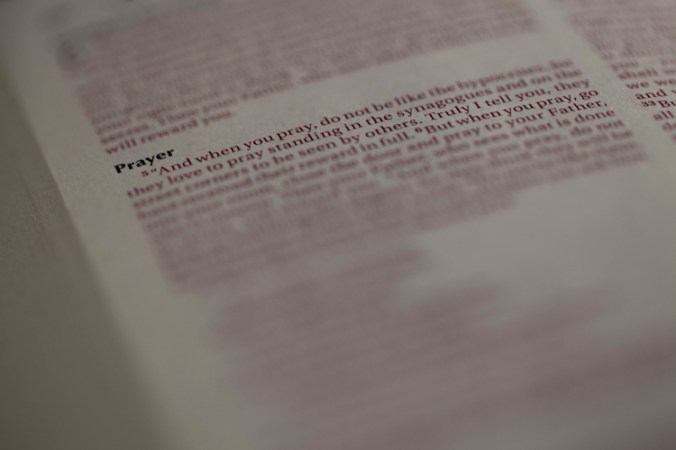
Whenever you pray, you must not be like the hypocrites, because they love to pray standing in the synagogues and on the street corners to be seen by people. Truly I tell you, they have their reward. But when you pray, go into your private room, shut your door, and pray to your Father who is in secret. And your Father who sees in secret will reward you.

Matthew 6:5–6, CSB

Have you ever come across someone who just loved to hear themselves pray?

I remember as a kid, there were always a couple men in the church who’d drawl on and on in their prayers, peppered by numerous “thous” or “thees.” They were always the same ones who’d volunteer to pray every Sunday, and they were the only ones, besides the pastor, who’d be wearing a suit on Sunday. As a kid, I always sensed they were talking more to the congregation than to God Himself. 

In the verses above, Jesus teaches us about the dangers of public praying—the danger of hypocrisy—of praying for show, of praying for the applause of man. 

To avoid such temptation, Jesus tells us we should pray privately. “When you pray, go into your private room, shut your door, and pray to your Father who is in secret.”  This is the verse from which we get the idea of a “prayer closet.” That’s because it’s how the King James Version originally translated it. 

The point, specifically, is to find a place where we wouldn’t be tempted to perform for others. The point, more generally, is to find a place where we simply wouldn’t be distracted … for any reason. And so, whether it’s the specific sin of hypocrisy or the general problem of distraction, “Go into your private room, shut the door, and pray to your Father.”

Now, does this mean we need to create a literal “private room,”a prayer closet, like the one depicted several years ago in the Christian film, The War Room? 

Maybe. But maybe not.

When we read the Bible, we always want to think about the intended meaning. I believe it’s this: Jesus is calling us to seek out a specific place for prayer that’s free from both temptation and distraction. A place where we can fully commit ourselves to both speaking and listening to the Lord. And because each person is different, this place is going to look different for each of us.

Jesus’ private room was usually on a mountain in the early morning hours, away from His disciples. 

But my private room is our dining room table at 7am. As far as privacy goes, it’s really not all that private. But because our older kids are already off to school by that time, and because our younger ones are still asleep, it’s actually a pretty private environment for me. 

Now, you might not have such a luxury. Your season of life might be different. But I’m confident you’ll still be able to find a regular place to meet with Him. It just might look different from mine. It might have to be at your office before you clock in. It might have to be on a walk around the neighborhood. It might have to be at a coffee shop with your noise-cancelling AirPods in your ears. It might have to be on your way home from work with the radio off. Or it might have to be at home, even with your kids running wild around you. 

Susanna Wesley was a stay-at-home-mom, who raised 10 children from the home but still made time for the Lord each day. We’re told she would sit in her favorite kitchen chair, throw her apron up over her head, and then spend up to two hours in prayer each day. And all this took place while her kids worked and played around her. The children knew that when mom had that apron up over her head, she was in her prayer closet and that they had better not disrupt her or allow their siblings to disrupt her during her time with the Lord. 

One has to ask what kind of influence such a commitment to prayer had upon her children. Well, history tells us. Susanna Wesley was the mother of John and Charles Wesley, two of the Church’s greatest evangelists.

Where does this leave us? 

Maybe our hearts have been a bit impure. Maybe our environment has been a bit too distracting. Whatever the case may be, the Lord has called us into intimate, vulnerable, and honest conversation with Himself. Therefore, we need to make time for Him. But we also need to find a place, as free from distractions as possible, where we can do this.

Do you have a private room? If not, will you find one this week? And going there, will you shut the door—cutting off the distractions of the world—to just meet with Him? 

For His Glory and Our Joy,

Scott Gourley

* This is part two of a four part series

Teach Us to Pray: When You Pray (Part 1)

Teach Us to Pray: When You Pray (Part 1)

Whenever you pray, you must not be like the hypocrites, because they love to pray standing in the synagogues and on the street corners to be seen by people. Truly I tell you, they have their reward. But when you pray, go into your private room, shut your door, and pray to your Father who is in secret. And your Father who sees in secret will reward you.

Matthew 6:5–6, CSB

Notice, in these verses He doesn’t command us to pray. Instead, he assumes that we’re going to pray. Look at what he says. “Whenever you pray” and “when you pray.” 

It’s a subtle reminder, but Jesus’ expectation is that we would pray. We breathe; we eat, and we pray. It’s just what we do. As those who have been born again, the Spirit gives us a godly desire to engage in ongoing, daily prayer. 

But the question remains: are we praying? 

On a regular basis, on a daily basis, are we spending time with the Lord?  Are we praying? Not just talking to Him or at Him. But talking with Him. Are we sharing our heart—our ideas, hurts, frustrations, desires? Are we listening to His voice—His concerns, His truths, His desires? And are we responding—to His voice, His leading, His correction, His calling? 

Have you been spending regular, quality time with the Lord? And if you haven’t, what needs to change in your life in order to make this happen? 

I’ve been personally convicted of this area of my life again. Sure, I pray. But it’s sporadic. It’s often hurried, done only in passing. And it’s usually one-sided. I’m really good at talking—venting about something or asking for something. But I still struggle with listening. 

This past week, I was convicted once again that I need to carve out specific time each day to just sit and listen to Him. And so, I’ve gone back to waking up early. Waking up before everyone else. Waking up and spending time with the Lord in prayer, before spending time on my phone. Because, sadly, that’s what I’ve become accustomed to doing in my normal routine. 

I really thought the first couple of days would be hard. But honesty, it really hasn’t been all that of a challenge. Instead, it’s been a joy. It’s been a time of spiritual rest, refreshment and renewal, a time of inner peace, something I wasn’t getting before.

“When you pray …” 

How’s your prayer life been? Sporadic? Scattered? Hurried? Selfish and one-sided? 

If so, it might reveal a need to become more intentional, more disciplined in your prayer life, to set aside a specific time each day to spend with the Lord. And if so, I encourage you to do just that. 

Jesus assumes that we’ll spend time in prayer. But let’s not assume it will happen without us prioritizing it. 

For His Glory and Our Joy,

Scott Gourley

* This is part one of a four part series

Teach Us to Pray: Go into Your Private Room (Part 2)

“We Will Never Forget?”

Today is September 11, 2021. It is the twentieth anniversary of the worst act of terror ever perpetrated upon the United States of America. I remember how the churches filled with people in the weeks following that day, and how these words filled the vengeful air; “we will never forget.” For some, these words were muttered angrily, for others they were simply an expression of sorrow and disbelief. But, nonetheless these were the words on every American tongue.

Since then, Americans have made countless attempts to erase the past. They have destroyed and defaced statues of historical figures, and spun endless narratives about the history of the country. History has become offensive in and of itself as interest groups revise and reinterpret the past so as to change the future. In short, everyone has their own version of events so that history, for better or worse, is more about ‘what happened according to my feelings,’ rather than simply ‘what happened.’ So, as we look back at that horrible day, can we still claim that we will never forget, and can we expect future generations to remember as we have? Can we expect them to never forget?

The Bible is full of exhortations for God’s people to memorialize events. In Exodus 13:14;

“And it shall be when your son asks you in time to come, saying, “What is this?” then you shall say to him, “With a powerful hand the Lord brought us out of Egypt, from the house of slavery.”

Jesus told his disciples to memorialize his death in the same way that they did the Passover meal; “Do this in remembrance of Me” (Luke 22:14-23).

A memorial is meant to extend past one’s own lifetime as an ordinance for future generations. But sometimes we can take for granted the sincerity and seriousness with which each generation should commemorate such events. We also may try to control others in our own attempts to commemorate or memorialize. As time passes, the seriousness and sincerity of the commemoration wanes, and some people will become frustrated with an “ungrateful generation.” But this is just a fact of life, as the Qoheleth tells us in Ecclesiastes 1:11

“There is no remembrance of earlier things; and also of the later things which will occur, there will be for them no remembrance among those who will come later still.”

So there you have it – we WILL forget. Maybe your generation will remember, but future generations will certainly forget. Those who come after you and whose actions, or lack thereof, are far beyond your control will most certainly forget. They will not hold certain truths to be “self-evident.” They will not hold high the values of human life and dignity in the same way. They may not hate certain manifestations of evil in the same way. They will revise human history as they see fit in order to have a narrative with which they feel comfortable. How do we know this? Because we have done the same things. Every generation revises history with a certain set of biases and cultural values. Sometimes the nuance is so insignificant that it is unrecognizable to the untrained eye. At other times, it is patently obvious to all. Either way, people and cultures change over time, and therefore the overall memory of humanity changes. It wanes and disappears, and we change and forget.

But there is ONE who does not change, nor does He forget.

His story is from old, for He was in the beginning (John 1:1). He does not change (Mal 3:6). He is Faithful and True (Rev 19:11). He will not forget His sheep. He will not forget His promise to those near and those far off. His righteousness does not wane over time, nor does He grow weary of interceding for His people. So, “though the earth should change and though the mountains slip into the heart of the sea; and though its waters roar and foam, though the mountains quake with swelling pride,” “we will not fear”(Psalm 46:2-3).

So even though we fail miserably to remember and honor the people and events of our past, let us be encouraged in the Lord, Jesus. His memory is not fickle. He will never forget. Nothing can separate us from His love, and His love does not wane over time.

He is coming again soon, and He will not forget.