What’s to do Now that Easter is Over?

What’s to do now that Easter’s over?

But is it truly over, Scott? 

Well, of course not. The knowledge of our Lord’s resurrection should always stay with us.

But, all the festivities of Easter are now past. The weekend itself is behind us. The big event has happened. And so, what now? What should we, as a church, be focusing our attention on next?

Well, fortunately, we don’t have to stumble into unknown territory, trying to figure this out. We can actually look to the Bible and take our cue from what the early church did next.

In Acts 1:4-5, we read:

While he was with them, he commanded them not to leave Jerusalem, but to wait for the Father’s promise. “Which,” he said, “you have heard me speak about; for John baptized with water, but you will be baptized with the Holy Spirit in a few days.”

It’s interesting that Jesus’ command wasn’t to “Go!” It wasn’t, “Leave Jerusalem and get busy!”It wasn’t, “Dream something up and go do it in my name!” 

That might be our default thinking. Matthew 28:19-20! The Great Commission! Charge the hill! Let’s go!

But Jesus didn’t command His disciples to get busy. Instead, He commanded them “to wait.” 

Not, “Go,” but, “Wait.” Probably the exact opposite of what the disciples wanted to hear. Probably the exact opposite of what you and I want to hear. Because I know that I want to do something. I want to make something happen. Check some boxes. See the fruit of my labor.

But the Lord said, “Wait.”

And wait for what? 

“For the Father’s promise.” Wait for “the Holy Spirit.”  

You see, the Lord was about to leave, and He knew that it would be impossible for His disciples to do anything apart from Him (John 15:5). And so, He was about to send them the Holy Spirit, the very indwelling presence of God Himself to empower them to do the work of the ministry.

Jesus knew it would be impossible for His disciples to do anything without the Holy Spirit. And it’s the same for us, church. We can do nothing without the miraculous, empowering work of the Holy Spirit. 

After Easter, Jesus told His disciples to wait for the Spirit and His movement, and that’s what they did. 

After the ascension, Luke goes on to tell us in Acts 1:12–14:

Then they returned to Jerusalem from the Mount of Olives, which is near Jerusalem—a Sabbath day’s journey away. When they arrived, they went to the room upstairs where they were staying: Peter, John, James, Andrew, Philip, Thomas, Bartholomew, Matthew, James the son of Alphaeus, Simon the Zealot, and Judas the son of James. They all were continually united in prayer, along with the women, including Mary the mother of Jesus, and his brothers.

The disciples did exactly what Jesus had commanded. They waited for the Spirit. They waited continually. They waited united. And they waited in prayer.

Continually,

United,

In Prayer.

What are we to do now that Easter’s over? 

I believe we’re to do the same. We’re to wait on the Spirit … continually, united, and in prayer.

Our Lord is risen! He now sits at the right hand of the Father, making intercession for His church. One day, He will return. But in the meantime, He is with us through His Spirit, working within us, among us, and through us. 

Easter’s over. And what are we to do now? 

Wait. Church, let us wait diligently on the Spirit to move. Let us wait, seeking the Spirit’s movement continually united in prayer. 

Let us wait prayerfully until He decides to move mightily!

For His Glory and Our Joy, 

Scott Gourley

Teach Us to Pray: You Should Pray Like This (Part 3)

When it comes to prayer, probably the most commonly asked question I get as a pastor is, “How does one pray?” Jesus’ own disciples asked Him this very question. And fortunately, He gave us a model on how to pray in Matthew 6:9-13. 

Let’s look at each of His statements individually.

Our Father in heaven

Jesus begins by telling us to address God as our Father in heaven. In Jesus’ day, this would have been a profound statement, as no Jew would have thought of God in those terms. But as Christians, we’re told that we have “received the Spirit of adoption, by whom we cry out, ‘Abba, Father’” (Romans 8:15). God is now Daddy. He is no austere king sitting far from us upon a throne, but He is our loving Father, stretching out His arms and engulfing us in His everlasting love. All of this is because of the work of the Son. For the Father “predestined us to be adopted as sons through Jesus Christ for himself, according to the good pleasure of his will” (Ephesians 1:5). It is Christ Himself who has made this our spiritual reality. 

And so, the first thing we ought to do as we begin to pray is to remember the unique identity we now enjoy as God’s children because of Christ Jesus. 

Your name be honored as holy

Second, Jesus teaches us that we should reflect on the holiness of God. Although the King now sits on the throne with outstretched arms, nonetheless, He still sits on the throne. We should never become so comfortable with the Lord as Father to forget Him as King. As we approach the throne of grace, we must still remember that He is holy, completely separate from us. We are creation; He is Creator. He alone is worthy of all worship. 

As we pray, we must recognize His holiness and give Him the reverence that He deserves. 

Your kingdom come, your will be done on earth as it is in heaven

Let’s be honest. Most of the time, we think the world revolves around us. And so, a lot of our time in prayer is spent petitioning the Lord about our desires and wants. But Jesus tells us our first concern is to be about the Lord’s will. As I have often said before, prayer is the process by which our hearts become more like His. As we spend more and more time with the Lord, He slowly changes our hearts to mirror His.

As we pray, we should be quick to listen and slower to speak because, as we spend time in His presence simply listening, we will come to know His heart and pray more for His will to be done, not ours.

Give us our day our daily bread

This speaks to our daily needs, not our wants. The Lord is faithful. He will provide. He has provided for our every need. Time and time again, the Lord has proven His faithfulness to us and has come through for us. We can trust Him to continue to take care of us as His beloved children. 

As we pray, we should make our requests known to him (Philippians 4:6) and trust that, as we pray for His coming kingdom (see above), “all of these things will be provided” for us (Matthew 6:28). 

Forgive us our debts as we forgive our debtors

Our debt has definitely been cancelled by the blood of Christ, who has made us alive and forgiven us from all our trespasses (Colossians 2:13-14). But until we get to heaven, we’re still going to continue to sin here on earth, which means we’re still going to need to confess that sin on a daily basis (1 John 1:9). The discipline of confession and repentance is an ongoing part of the Christian life we cannot neglect. When we do, it not only effects our relationship with the Lord but with our neighbors as well. That’s because our inability to extend mercy to others is directly related to our inability to fully understand the depths of His mercy for ourselves (Matthew 18:21-35). 

As we pray, we must continue to confess the sin the Holy Spirit brings to our attention. And we must repent if we have somehow refused to extend the Lord’s grace to others who desperately need it as well. 

And do not bring us into temptation, but deliver us from the evil one

Whereas, the previous exhortation was to pray for forgiveness from particular sins, here the emphasis is on praying for God’s help in keeping us from future sin. With a world so full of sin, an evil one so bent on our destruction, and our own hearts that are still so “prone to wander,” we must daily ask for the Lord’s continued grace to guide and protect us from evil. 

As we pray, we would do well to remember John Bradford’s famous words, “There go I but for the grace of God,” and seek the Lord’s kindness in delivering us from all forms of evil. 

________________________

Jesus’ teaching on prayer is not meant to be a prayer we recite daily (although one could). Instead, it’s a model of how we should pray. It speaks to the main things a prayer should cover. Often, I know in my own prayer life, I tend to focus on just one of these areas—my needs, requests, and petitions. But our prayers should be much broader than that, much richer than that. Because as we pray more broadly, we see Him more broadly. Instead of just focusing on ourselves, we see Him—as Loving Father, Holy God, Sovereign King, Merciful Savior, and Mighty Deliverer.

For His Glory and Our Joy,

Scott Gourley
Teach Us to Pray: Go into Your Private Room (Part 2)

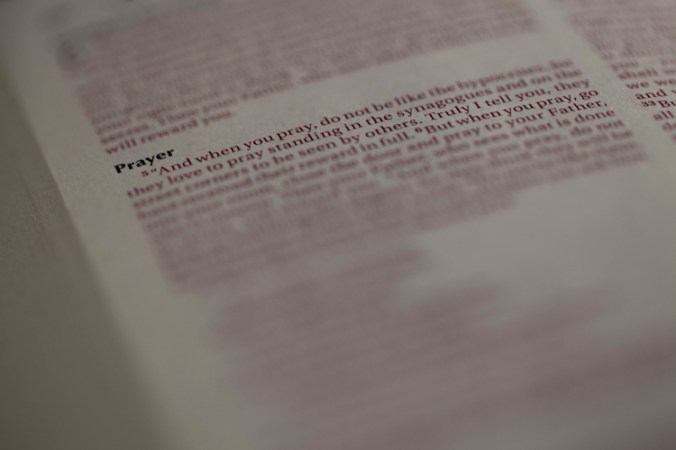
Whenever you pray, you must not be like the hypocrites, because they love to pray standing in the synagogues and on the street corners to be seen by people. Truly I tell you, they have their reward. But when you pray, go into your private room, shut your door, and pray to your Father who is in secret. And your Father who sees in secret will reward you.

Matthew 6:5–6, CSB

Have you ever come across someone who just loved to hear themselves pray?

I remember as a kid, there were always a couple men in the church who’d drawl on and on in their prayers, peppered by numerous “thous” or “thees.” They were always the same ones who’d volunteer to pray every Sunday, and they were the only ones, besides the pastor, who’d be wearing a suit on Sunday. As a kid, I always sensed they were talking more to the congregation than to God Himself. 

In the verses above, Jesus teaches us about the dangers of public praying—the danger of hypocrisy—of praying for show, of praying for the applause of man. 

To avoid such temptation, Jesus tells us we should pray privately. “When you pray, go into your private room, shut your door, and pray to your Father who is in secret.”  This is the verse from which we get the idea of a “prayer closet.” That’s because it’s how the King James Version originally translated it. 

The point, specifically, is to find a place where we wouldn’t be tempted to perform for others. The point, more generally, is to find a place where we simply wouldn’t be distracted … for any reason. And so, whether it’s the specific sin of hypocrisy or the general problem of distraction, “Go into your private room, shut the door, and pray to your Father.”

Now, does this mean we need to create a literal “private room,”a prayer closet, like the one depicted several years ago in the Christian film, The War Room? 

Maybe. But maybe not.

When we read the Bible, we always want to think about the intended meaning. I believe it’s this: Jesus is calling us to seek out a specific place for prayer that’s free from both temptation and distraction. A place where we can fully commit ourselves to both speaking and listening to the Lord. And because each person is different, this place is going to look different for each of us.

Jesus’ private room was usually on a mountain in the early morning hours, away from His disciples. 

But my private room is our dining room table at 7am. As far as privacy goes, it’s really not all that private. But because our older kids are already off to school by that time, and because our younger ones are still asleep, it’s actually a pretty private environment for me. 

Now, you might not have such a luxury. Your season of life might be different. But I’m confident you’ll still be able to find a regular place to meet with Him. It just might look different from mine. It might have to be at your office before you clock in. It might have to be on a walk around the neighborhood. It might have to be at a coffee shop with your noise-cancelling AirPods in your ears. It might have to be on your way home from work with the radio off. Or it might have to be at home, even with your kids running wild around you. 

Susanna Wesley was a stay-at-home-mom, who raised 10 children from the home but still made time for the Lord each day. We’re told she would sit in her favorite kitchen chair, throw her apron up over her head, and then spend up to two hours in prayer each day. And all this took place while her kids worked and played around her. The children knew that when mom had that apron up over her head, she was in her prayer closet and that they had better not disrupt her or allow their siblings to disrupt her during her time with the Lord. 

One has to ask what kind of influence such a commitment to prayer had upon her children. Well, history tells us. Susanna Wesley was the mother of John and Charles Wesley, two of the Church’s greatest evangelists.

Where does this leave us? 

Maybe our hearts have been a bit impure. Maybe our environment has been a bit too distracting. Whatever the case may be, the Lord has called us into intimate, vulnerable, and honest conversation with Himself. Therefore, we need to make time for Him. But we also need to find a place, as free from distractions as possible, where we can do this.

Do you have a private room? If not, will you find one this week? And going there, will you shut the door—cutting off the distractions of the world—to just meet with Him? 

For His Glory and Our Joy,

Scott Gourley

* This is part two of a four part series

Teach Us to Pray: When You Pray (Part 1)

Teach Us to Pray: When You Pray (Part 1)

Whenever you pray, you must not be like the hypocrites, because they love to pray standing in the synagogues and on the street corners to be seen by people. Truly I tell you, they have their reward. But when you pray, go into your private room, shut your door, and pray to your Father who is in secret. And your Father who sees in secret will reward you.

Matthew 6:5–6, CSB

Notice, in these verses He doesn’t command us to pray. Instead, he assumes that we’re going to pray. Look at what he says. “Whenever you pray” and “when you pray.” 

It’s a subtle reminder, but Jesus’ expectation is that we would pray. We breathe; we eat, and we pray. It’s just what we do. As those who have been born again, the Spirit gives us a godly desire to engage in ongoing, daily prayer. 

But the question remains: are we praying? 

On a regular basis, on a daily basis, are we spending time with the Lord?  Are we praying? Not just talking to Him or at Him. But talking with Him. Are we sharing our heart—our ideas, hurts, frustrations, desires? Are we listening to His voice—His concerns, His truths, His desires? And are we responding—to His voice, His leading, His correction, His calling? 

Have you been spending regular, quality time with the Lord? And if you haven’t, what needs to change in your life in order to make this happen? 

I’ve been personally convicted of this area of my life again. Sure, I pray. But it’s sporadic. It’s often hurried, done only in passing. And it’s usually one-sided. I’m really good at talking—venting about something or asking for something. But I still struggle with listening. 

This past week, I was convicted once again that I need to carve out specific time each day to just sit and listen to Him. And so, I’ve gone back to waking up early. Waking up before everyone else. Waking up and spending time with the Lord in prayer, before spending time on my phone. Because, sadly, that’s what I’ve become accustomed to doing in my normal routine. 

I really thought the first couple of days would be hard. But honesty, it really hasn’t been all that of a challenge. Instead, it’s been a joy. It’s been a time of spiritual rest, refreshment and renewal, a time of inner peace, something I wasn’t getting before.

“When you pray …” 

How’s your prayer life been? Sporadic? Scattered? Hurried? Selfish and one-sided? 

If so, it might reveal a need to become more intentional, more disciplined in your prayer life, to set aside a specific time each day to spend with the Lord. And if so, I encourage you to do just that. 

Jesus assumes that we’ll spend time in prayer. But let’s not assume it will happen without us prioritizing it. 

For His Glory and Our Joy,

Scott Gourley

* This is part one of a four part series

Teach Us to Pray: Go into Your Private Room (Part 2)

In Community, We See Love for Us

One of our values at The Way Fellowship Church is Biblical Community. It’s something we talk a lot about—that, as a church, we have not only been separated unto Christ but we have also been separated to one another, that in Christ we have not only received a spiritual Father but we have also received a spiritual family. And so, because of this, we practice covenantal membership, believing that we not only gather as His church to receive from one another but also to give to one another. More than that, we believe that it’s in this community of giving sacrificially and loving unconditionally, that we see His very love for us.

Jesus tells us, “By this all people will know that you are my disciples, if you have love for one another” (John 13:35, ESV). What this means is that our very love for one another is one of the ways we testify, together, to the reality of Jesus’ power and authority to save. It is our love for one another that reminds us of His very love for us. 

And it’s this very truth that God has so graciously reminded me of recently. 

Two and a half weeks ago, I found myself in the hospital, battling another case of severe diverticulitis. This would become my third hospitalization for this issue. But the problem became even more compounded as I was being admitted. Sitting in the ER room, I received a call from my wife, who informed me that she and my son had both tested positive for Covid. This meant I needed to be tested, too. And low and behold, I turned out to be positive for Covid as well. 

Now, to fill in a little background, I had had some mild symptoms the week before—physical exhaustion, a slight running nose, and some mild pressure in my shoulder blades—but I had tested negative earlier that Wednesday. I assumed I had just been overextending myself. Sadly, this was not the case. I had Covid, and although the symptoms were gone by Friday, Covid had exasperated my diverticulitis and brought me painfully to the hospital. 

And so, after a night in a closet of the ER and after a couple abscess were drained on my large intestine the next day, I was eventually admitted to the Covid ward of the hospital. 

And it freaked me out. Severely. I was wheeled through the doors of the ward and passed open door after open door of people coughing, moaning, and even crying. I was wheeled past my “neighbor,” who looked like he was on death’s door, who couldn’t stop hacking all night long. 

I can honestly say, it was one of the scariest moments of my life. I still remember thinking:  I came in for diverticulitis, not this. My wife and kids are at home battling it, and I can’t be with them to help them. I kicked all the symptoms Friday; is the diverticulitis now going to make me immune-compromised? Are the Covid symptoms going to come back even more aggressively? Am I going to end up on a ventilator … like so and so? Sadly, I even asked: Lord, is this punishment for something I’ve done? 

The whole situation messed me up good. I had a panic attack going for the next twelve hours straight. I couldn’t think. And when I did, it was completely irrational. I was the proverbial emotional rollercoaster.  Completely isolated from everyone, except my Spanish-speaking-only neighbor, I felt utterly alone. And honestly, even though I’m a pastor whose job is to teach theology, I had a hard time clinging to that very theology—that Jesus is good, Jesus is great, Jesus is sovereign, Jesus is wise, Jesus is compassionate, Jesus is powerful, Jesus is Healer. 

But by His grace, I did. By His grace, I held fast to what I knew of His character and to His eternal promises.

And here’s where I finally come to the point of this article, and that is the importance of biblical community. The one thing that helped me to cling to Christ more than anything else, the lifeline in that dark and depressing room, was my church community. Although I was completely shut off from the world, I was constantly reminded of God’s love for me, of His power to heal me, of my brothers and sisters who were all praying for me. 

That first night in the Covid ward, Pastor Don called me and just listened, and then he prayed for me. He didn’t just say he was going to pray for me; he did. Oh how my soul needed that! One by one, pastors from the Pillar Network texted me. One called and also prayed directly with me. The wife of one of the Pillar pastors, a nurse practitioner with expertise in diverticulitis, conference-called Christy and I and helped us process some of the decisions we were having to make. There were two guys from the state SBC convention who checked in on me. My family FaceTimed me, and I got to talk to them during their dinner. Later the next morning, I got a text from Jason, asking me if I wanted him to “break me out,” which made me laugh for the first time in a long time. That was followed by a call from Jerry and then numerous, encouraging texts from Gary, Patsy, Pam, Lesley, Kaylob and a bunch of others (I’m sorry if I forgot you—again, I was in a fog). All of these encouraged me to hold to God’s promises, that I was not alone. At one point, I texted Nola and David, because I knew they would pray intensely for me, and I was so thankful when she quickly replied with her kind, encouraging words.

Here’s the truth, friends. I can’t image what it would have been like to have gone through such an ordeal by myself, to try to white-knuckle through it without my church family praying for me. I was alone. But I really wasn’t. God was with me. And my church family continued to remind me of this truth until I was eventually released later that Wednesday. 

It’s in our suffering that God uses the love of His church to express His greater love for us. It’s in these moments that we’re reminded that we really do need each other and that we really do have each other. 

Biblical community. We don’t realize just how important it is until we’re in desperate need of it. We might not know just how important it is to to go out of our way and show Christ’s love to others who are suffering until we experience the loving embrace of the Lord’s community, firsthand, for ourselves. 

“By this all people will know that you are my disciples, if you have love for one another.”